Aluminium Dumping
Our local aluminium manufacturing industry is in mortal danger. Are our politicians and MBIE moving fast enough?
The threat comes from imports priced below the cost of manufacture. Some aluminium extrusion products are being imported into New Zealand at or below the international price of the aluminium billet that extrusions are made from.
That is, these products are being sold at well below the price of the raw materials, let alone their full cost of production. No unsubsidised business could produce products at a loss like this. It is not just competition. It is the result of global overcapacity and state subsidisation, particularly in China, with surplus volume diverted to New Zealand as other markets protect their industries.
Globally, countries have made strong moves to level the playing field:
Australia: anti-dumping and countervailing duties on Chinese aluminium extrusions since 2010, most recently extended in October 2025. Australia sends a greater share of its exports to China than New Zealand does and applies duties on Chinese aluminium as a matter of routine, without retaliation over those duties.
European Union: anti-dumping duties of 21 to 32 percent on Chinese aluminium extrusions since 2021, currently under review for extension.
United States: anti-dumping duties on Chinese aluminium extrusions since 2011, and tariffs of 50 percent on aluminium imports from all sources (except UK, which is 25 percent) since June 2025.
Canada: anti-dumping and countervailing duties on Chinese aluminium extrusions since 2009 (extended in 2025), plus a 25 percent surtax on all Chinese steel and aluminium products since October 2024.
United Kingdom: anti-dumping duties of 15.4 percent on Chinese aluminium extrusions since December 2022.
All the industry is asking for is a level playing field.
ALENZ briefing - safeguard action.pdf
Medical School
The University of Waikato’s Graduate School of Medicine is probably the biggest infrastructure and wellbeing project for the Waikato in recent decades. Medical schools last hundreds of years, and their graduates fix us when we are ill, so it is a game changer for the health and wellbeing of regional New Zealand.
What we like is twofold.
The first is the focus on prevention rather than cure. It is so obvious and logical. Its focus is more graduates choosing primary care. More GPs means patients see doctors faster. That then sees a reduction in the queues both at community GP level and in the queues at Waikato Hospital. People are seen quicker, get diagnoses and treatment faster, and live healthier lives.
The second is that the creation of the Medical School creates a medical industry which gives huge economic benefits to Hamilton and the Waikato.
What many miss is the economic contribution a Medical School makes to a region. Medical schools have long lives, counted in centuries. A large health industry will evolve around the Medical School. It will employ Waikato people, attract mature medical students who will stay to work in our region. It is already attracting highly talented staff from around the world. Their arrival brings dollars into our region. They are a cohort that will boost our GDP.
Importantly, the Medical School will act as a catalyst to create companies that will develop new products. That will lead to new businesses emerging in the Waikato. From those new businesses and products will come health and wellbeing initiatives that will make us healthier.
It will boost our regional GDP and our prosperity. We are already seeing medical conferences moving here. Major NZ healthcare conference chooses Hamilton for next phase of growth - Conference and Meetings World | Global MICE Industry News from CMW
We are unabashedly enthusiastic and supportive of the Waikato Medical School.
For economic development, the health and wellbeing of our families, friends and colleagues, supporting the Waikato Medical School is a no-brainer.
It is one of the best economic development projects of our time.
Future generations will thank us for it.
Positive Economic News
By any measure, the opening of the financial books should have given the media something to be positive about. But true to their recent form, many commentators looked for and commented on the negatives.
Are our economic pundits at the Herald, Stuff and elsewhere paid to see despair and doom? Businesspeople by their nature are positive people. They need to be mildly optimistic or better, otherwise they would sell up and head to a beach.
The media is certainly not making us feel positive.
A stronger tax take means businesses are making a better surplus and having to pay more tax. Let us be thankful that they are making a surplus and must pay tax. The fact they are paying more tax is a good sign that the economy is moving forward and not in reverse.
Things are happening in our economy.
The historical data is not too bad, and Forsyth Barr took the temperature of business recently with their latest survey the-pulse-of-nz-business-2026-09-21-forsyth-barr-business-survey.
And business gets on with the job of making things happen.
Sleepyhead expands Sweet dreams: Sleepyhead town vision takes step forward | Waikato Times
The 2026 Election is Frustrating if You Want Facts
Getting political parties to cost their promises is difficult. Their promises are so convoluted, Byzantian in their complexity, downright hard to compare and probably bulldust at best.
It may just come down to who you can trust.
We are politically neutral. For the Chamber, it is what is best for business, full stop.
Thomas Coughlan has tried to analyse the Labour Party promises, Election 2026: Labour has a case to answer regarding Nicola Willis’ alleged ‘hidden bill’ – Thomas Coughlan - NZ Herald
For the sake of good democracy and to allow voters to judge, it is necessary for all parties to be transparent with their promises and very clear about how they will raise the revenue to cover the expenditure they promise to spread around. Because the revenue will come from our members and their businesses, we need to know very clearly who is promising what and for how much.
At present, there is a cacophony of political messages on social media.
The days of the occasional town hall meetings of candidates have been drowned out by digital access to political parties’ policies and candidates’ promises.
The Taxpayers Union has created the New Zealand Politicians Bribe-o-Meter, and Infometrics had a Look at PREFU
For the cynical person looking at the costs of party policies may enjoy the latest “reveal” of the price you will have to pay for their election “promises/bribes”. 2026 Election "Bribe-O-Meter" Launched - Taxpayers' Union
Infometrics had a look at PREFU and concluded there was “More money, and more problems for political parties”
For those who like data, here is their take on the latest Economic and Fiscal Update (29 September, 2026).
Here are the key numbers for you to use in your business planning and your voting...
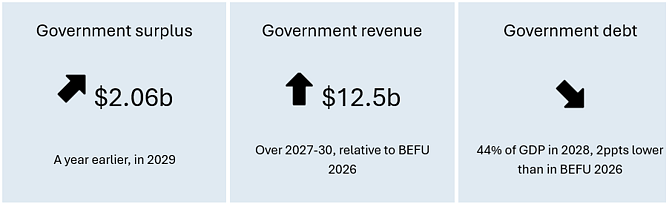
The Treasury’s (PREFU) forecasts an earlier return to surplus.
With a $2.06b OBEGAL surplus (operating balance before gains and losses) now expected in 2028/29, compared to a $608m deficit expected in Budget 2026.
The improvement in the fiscal position is underpinned by stronger revenue growth, with expenses barely changed.
Core Crown revenue collected is set to be $12.5b higher over the 2027-2030 period compared to Budget 2026, with a stronger tax take in the recently ended financial year helping the revenue starting point too.
Net Core Crown debt is set to be $13.4b smaller (5.4%) in 2030 than was forecast at Budget 2026.
As a percentage of GDP, this debt measure is now expected to peak at 43.9% of GDP in 2028, around two percentage points lower than in Budget 2026, and to fall below 40% in 2031.
On this measure, the actual value of debt is set to fall in 2031 for the first time in 13 years.
Stronger revenue and lower debt mean bond issuance from the Debt Management Office is set to be $4b lower in 2026/27 and $15b lower over the forecast period.
Treasury highlighted several ongoing fiscal challenges that a future government will need to confront, including superannuation.
Superannuation costs are set to rise from $26.5b in 2026/27 to $32.9b in 2030/31, a $6.4b lift – split evenly between more recipients and indexation to account for higher wages. By 2031, 28% of total tax take will be taken up by NZ Super and interest costs alone.
The saying “May you live in interesting times” has many meanings, but all apply to the time we are in now and for our foreseeable future.
Vote well.